
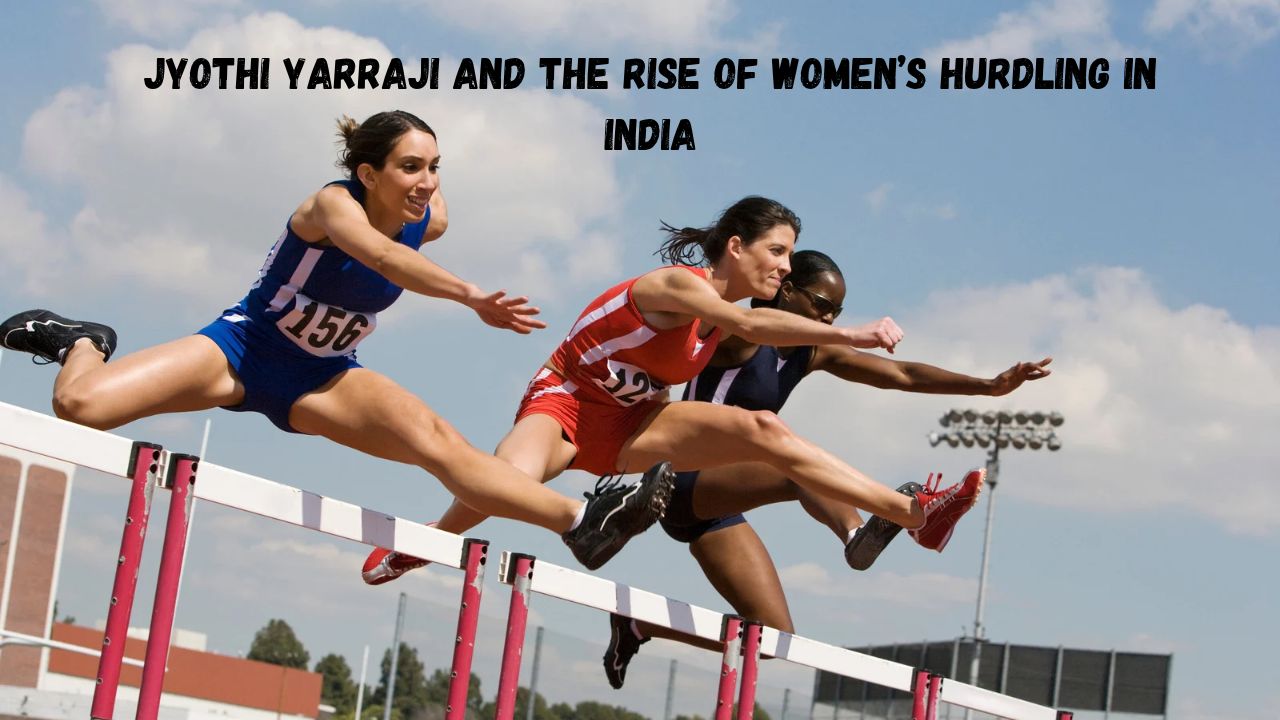
Women’s 100-metre hurdles occupied a limited place in Indian athletics for years. The event requires sprint speed, precise technique, rhythm between barriers, and the ability to reproduce those elements under pressure. India had produced capable hurdlers, but reaching times that could create opportunities in major international competition remained difficult. Jyothi Yarraji changed the discussion by repeatedly lowering the national benchmark and making the event more visible within Indian track and field.
Her progress also shows why hurdling cannot be understood simply as sprinting with obstacles. While spectators may move between athletics coverage and unrelated entertainment such as an andar bahar card game, Yarraji’s event depends on a sequence in which every fraction of a second is connected to technique. The start affects the first hurdle, the first hurdle affects the rhythm that follows, and one technical error can influence several barriers. Her rise has therefore provided a useful model for examining how Indian women’s hurdling can develop.
Sprint Speed Creates the Foundation
A hurdler must first be able to sprint.
The barriers change the mechanics of the race, but they do not eliminate the importance of acceleration and maximum velocity.
Yarraji’s development has depended on improving the speed she can carry through the full 100 metres.
This is important because an athlete cannot compensate for limited sprint capacity through hurdle technique alone.
At the same time, raw speed is not sufficient. A fast athlete who loses momentum over every barrier may produce a slower result than a runner with better rhythm.
The event rewards the integration of both qualities.
The First Hurdle Establishes the Race
The opening phase has a disproportionate influence on a 100-metre hurdles race.
Athletes accelerate from the blocks while preparing to clear the first barrier without breaking their running pattern.
Arriving too close can force an inefficient takeoff. Arriving too far away can increase flight time.
Yarraji must therefore reproduce the relationship between start mechanics and hurdle distance during training.
Once the first clearance is completed well, the athlete has a better chance of establishing the three-step rhythm used between barriers.
A poor first hurdle, by contrast, can turn the rest of the race into a correction exercise.
Efficient Clearance Reduces Lost Time
The goal of hurdling is not to jump high.
The athlete needs to clear the barrier with enough height for safety while keeping the center of mass moving forward.
Excessive vertical movement increases time in the air and interrupts horizontal velocity.
Yarraji’s technique depends on coordinating the lead leg, trail leg, trunk, and arms so that landing prepares the next sprint step.
This is where technical repetition becomes essential.
The athlete needs the movement to remain stable at race speed, not only during controlled drills.
Technique that works slowly may fail once competitive velocity is introduced.
Rhythm Connects Ten Separate Obstacles
The barriers are physically separate, but an elite hurdler cannot treat them as ten independent problems.
Each clearance creates the entry into the next section.
The three strides between hurdles must fit the athlete’s speed and body mechanics. If one landing changes stride length, the following takeoff point can also change.
Yarraji’s task is therefore to preserve rhythm even when a clearance is imperfect.
This ability separates competition technique from practice perfection.
A race rarely provides ten identical hurdle contacts. The athlete must make small corrections without allowing one error to disrupt the entire sequence.
National Records Changed the Standard
Yarraji’s repeated improvements to India’s national record have changed the performance level associated with women’s hurdling in the country.
Records serve as more than historical statistics.
They provide targets for athletes and coaches.
When the national benchmark falls, training expectations can shift with it. Times that once represented the highest domestic level become intermediate objectives for the next group.
This is one way an individual athlete can influence an event without directly coaching other competitors.
The performance itself changes what younger hurdlers consider possible.
International Racing Adds Necessary Pressure
Domestic success cannot reproduce every demand of international competition.
Stronger fields expose athletes to faster starts and runners capable of maintaining pressure across all ten hurdles.
Yarraji’s international experience has therefore been important to her development.
Racing against faster opposition provides information about where time is being lost.
The difference may come from the start, hurdle clearance, transitions, or the final sprint after the last barrier.
Competition turns those differences into measurable evidence.
Training can then be adjusted around what the race revealed.
Strength Training Must Support Technique
Hurdling requires force production, but strength has to serve movement.
The athlete needs power for acceleration and enough stability to control repeated takeoffs and landings.
However, adding strength without maintaining speed and mobility can create another problem.
Yarraji’s preparation therefore has to balance sprint sessions, technical hurdle work, gym training, recovery, and competition.
The objective is not maximum strength in isolation.
It is producing force quickly while preserving the positions required for efficient clearance.
This integration is especially important because the race leaves almost no time to correct large technical errors.
Visibility Can Improve the Event Around Her
Successful athletes attract attention to disciplines that previously received less coverage.
For women’s hurdles in India, Yarraji’s results have created a recognizable reference point.
That visibility can matter for young athletes deciding which event to pursue.
It can also increase interest in coaching methods, competition opportunities, facilities, and athlete support.
One runner cannot create a complete development system, but performance can create demand for one.
If more athletes enter the event and receive structured training earlier, the national depth can improve.
The Next Challenge Is Depth
The development of an event cannot be measured only by the fastest athlete.
A stronger system needs several competitors capable of pushing one another.
Domestic competition then becomes more useful because athletes face pressure before entering international meetings.
Yarraji has established a benchmark.
The next stage for Indian women’s hurdling is producing more runners capable of approaching that standard.
This requires coaching knowledge, access to suitable tracks, technical development from junior levels, strength preparation, and enough competitions to practice race execution.
What Yarraji Has Changed
Jyothi Yarraji’s importance lies in connecting individual progress with a broader shift in expectations.
Her performances have demonstrated that Indian women’s hurdling can move toward international standards through a combination of sprint development, technical work, rhythm, strength, and competition exposure.
The effect extends beyond record times.
Young hurdlers now have a domestic athlete whose races provide a technical and competitive reference.
That does not guarantee that India will produce a large group of world-level hurdlers. It does, however, change the starting point.
Yarraji has pushed the national benchmark forward. The long-term question is whether Indian athletics can turn that individual breakthrough into enough coaching, competition, and athlete depth to move the entire event forward with her.